How LitRPG Readers Can Analyze LitRPG Mechanics Like Pros
How to tell what makes one litRPG system better than another.

I love Systems. God, how I love them. Those perfect blue screens. Those crunchy numbers begging to go up. But I'm no scientist. No game scientist. So I struggle to talk about why I love a System in a way that's more coherent than, "I just like it, man!"
Yu-kai Chou, founding father of Octalysis game analysis, gave me the tools I needed to call a spade a spade. He's counseled corpos and suits (I'm talking government) across the world. Presumably, teaching them how to rule the plebs without spooking them. Heaven knows, they could use the help. Here in the good ol' US of A, we trust Uncle Sam about as far as we can throw him off his party yacht.
If it works for the big whigs, it's good enough for me. I'll briefly go over the Octalysis method and how scrubs like me use it to talk about litRPG mechanics.
Eight core drives
Yu-kai uses the Octalysis diagram to highlight eight reasons people play games. (Well, nine, but the ninth is a secret.) These are the eights drive inside the blue octagon shown below.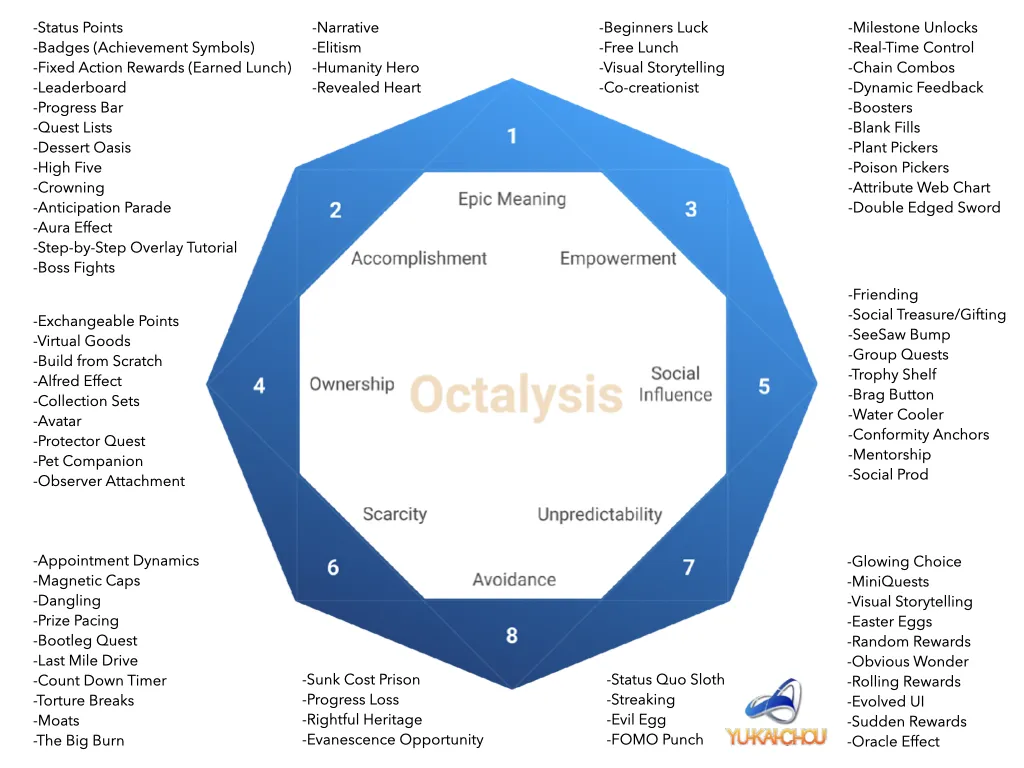
Source: Yu-Kai Chou blog
The point of this octogon is for game designers to tie every feature to one or more of these core drives. If it doesn't advance a core drive, why bother? On the flip side, if something taps into two or more core drives, it might be a keeper.
How to analyze litRPG mechanics
Is a System merely good, or is there something specific we can point to? Something about human nature it taps into. A core drive, perhaps.
Let's get specific.
Aleron Kong's Chaos Seeds series has a system so good, the series thrives despite a slow start, a hand-wavy plot, and a main character who's kind of a gag.
Why?
Core Drive #1: Epic meaning - The prologue begins with gods chit-chatting about ominous things to come. Richter spawns with a powerful, mysterious sponsor. The series lets us know, in drips and drabs, that our MC is at the center of something bigger than himself. In fact, the System announced Richter's epic achievements across The Land, screaming "this guys is super important and matters!"
Core Drive #2: Accomplishment - Richter accomplishes quests, works to defeat bosses, earns leadership perks, and levels up. There's a strong sense of momentum across multiple fronts. Arguably, momentum is one of the series' strongest points. As the author adds more Systems to progress, Richter's seems to move through the narrative faster and faster. I'm gasping, folks.
Core Drive #3: Empowerment - Quest milestones, interactive System screens, branching skill trees, and responsive base upgrade paths give the reader a sense that the setting cares about what Richter wants, that anything could happens, if he works hard enough. It feels freeing. Say what you will about Richter, he has a strong sense of agency.
And that's only three of the core drives. If you want to know the rest, check out Yu-kai Chou's website or this Amazon affiliate link to his book Actionable Gamification: Beyond Points and Leaderboards. Out of the books I've read on game mechanics, it's the only one that doesn't feel like slog.
More books with great game mechanics
The Chaos Seeds series taps into all eight core drives, injecting the veins of litRPG fans like me with liquid nitrogen. Did I mention litRPGs can be terribly addictive? No, I'm not a junkie, I'm just sad and pitiable. (Dabs eyes.) Hmm? You'd like to loan me your favorite litRPG book? Don't mind if I do!
Two more reccs: The Digital Rebirth Chronicles uses game mechanics to tap strongly into Core Drive #5 better than any other series I've read. Seaborn, an inactive and incomplete story on Royal Road, nevertheless has one of the best progression systems I've ever seen, hands-down.
Pssst. You can check out Aleron King's first book in the Chaos Seeds series through this affiliate link. Like most litRPGs on Amazon, it's available on Kindle Unlimited. Frankly, I credit KU to making litRPG as popular as it is. So cheap, much wow. Thanks Kong!